
Have you ever started an exciting Arduino project only to realize you are tethered to a wall outlet? Whether you are conducting field experiments or deploying a remote IoT monitoring system, a mobile power solution is essential. Solar energy offers a sustainable, renewable way to keep your microcontrollers running indefinitely. In this guide, we’ll explore how to harness the sun to power your Arduino using practical, real-world solutions.
Recommended Preliminary Reading
To get the most out of this guide, we recommend reviewing our previous tutorials on solar power management:
- How to Choose a Solar Panel for Your Project
- Building a Solar Power Supply with Battery Backup
- DIY Joule Thief Circuit for Low-Voltage Harvesting
- Designing a DIY LiPo Charger
- How to Estimate Battery Life for Embedded Systems
The Challenge: Harnessing Variable Energy
The sun provides abundant energy, but solar panels produce variable voltage based on light intensity. To safely power an Arduino, this fluctuating energy must be regulated to a steady 5V and stored in a battery to ensure the project stays alive during the night or on cloudy days.
The Solution: Ready-Made 5V Solar Modules
For most makers, using a dedicated 5V solar charger/regulator module is the most efficient path. These modules act as the interface between the solar panel and the Arduino, managing the charging of an internal lithium battery and providing a regulated 5V USB output.
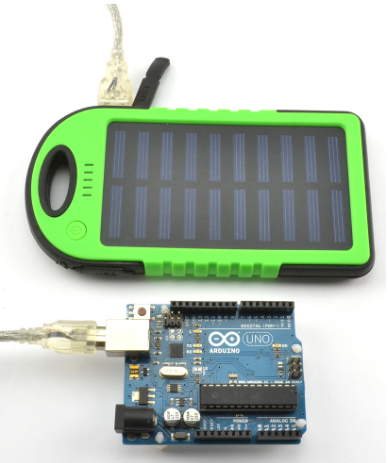
Why use a pre-built circuit? Designing a custom Li-ion charging circuit requires precise overvoltage and thermal protection. Ready-made modules handle these intricacies, allowing you to focus on your code and sensors.
Calculating Your Power Budget
To determine if your solar setup is feasible, you must calculate the "run-time" based on your battery capacity. For example, a standard Arduino Uno consumes approximately 50mA during normal operation. If you use a 4000mAh (4Ah) battery/charger:
$$\text{Run Time} = \frac{\text{Battery Capacity (mAh)}}{\text{Device Consumption (mA)}}$$$$\text{Run Time} = \frac{4000\text{ mAh}}{50\text{ mA}} = 80\text{ Hours}$$This means a fully charged 4Ah battery can power the Arduino Uno for about 80 hours without any sunlight.
Optimizing for Maximum Efficiency
While the Uno is great for prototyping, its onboard voltage regulators and USB-to-Serial chips waste significant energy. To extend your project's life, consider these upgrades:
- Switch to the Arduino Pro Mini: This board uses the same ATmega328P but lacks the power-hungry USB chip. At 5V, it can consume as little as 16mA.
- Utilize Sleep Modes: Using software libraries to put the MCU into "Deep Sleep" between sensor readings can reduce consumption to micro-amps, allowing a small battery to last for months.
- Low-Dropout Regulators (LDOs): Replace standard regulators with high-efficiency versions to minimize heat waste during voltage conversion.
Conclusion
Solar power is the key to unlocking truly autonomous Arduino projects. By combining efficient charging circuits with low-power hardware choices, you can deploy environmental sensors or remote monitors that run indefinitely. Whether you are a hobbyist or a developer, the sun offers a reliable, eco-friendly energy source for the next generation of IoT devices.
